
LED Pickleball Court Lighting Designed for Clearer Play, Lower Glare & Better Control
Creative Lighting Solutions helps clubs, sports facilities, municipalities, schools, HOAs, resorts, developers and commercial property owners plan high-performance LED pickleball court lighting for indoor and outdoor facilities. From our Plainview, New York base, we support projects across Long Island, Southwest Florida including Naples, and qualified projects nationwide with lighting design, fixture selection, photometric planning, retrofit guidance and controls.
More Lumens Do Not Automatically Create a Better Pickleball Court
Pickleball puts a small, fast-moving ball in front of players whose eyes are constantly changing direction. One moment a player is looking across the net, the next upward toward a lob, then toward a sideline or adjacent court. That makes fixture placement, beam control, uniformity and glare management far more important than simply replacing old lights with higher-output LEDs.
A court can measure bright and still feel uncomfortable. Hot spots near poles, dark zones between fixtures, glare at common player sightlines and excessive spill beyond the fence can all undermine the result. Indoor facilities add their own issues: ceiling height, trusses, HVAC equipment, nets, wall color and multiple adjacent courts can affect how the light is distributed and perceived.
Creative Lighting approaches a pickleball project as a complete lighting problem. We review the court arrangement, existing poles or mounting points, current fixtures, hours of use, desired level of play, neighboring properties, controls and the owner’s operating goals before recommending equipment. That same design-first philosophy is used throughout our sports facility LED lighting work.
What We Review Before Specifying Pickleball Lights
- Number and orientation of courts
- Indoor versus outdoor conditions
- Existing pole locations or ceiling mounting points
- Mounting height and structural limitations
- Current fixture type, wattage and condition
- Target level of recreational or competitive play
- Uniformity across baselines, kitchen and sidelines
- Glare at common player viewing angles
- Light spill toward homes, roads or adjacent spaces
- Zoning, scheduling, dimming and control opportunities
Six Performance Priorities That Matter on the Court
The best pickleball lighting system is not the one with the most impressive fixture specification sheet. It is the one that makes the court easier to use, easier to manage and more comfortable for players while respecting the site around it.
Reduce Bright and Dark Patches
The ball should not disappear visually as it moves from one area of the court to another. A photometric layout helps evaluate how fixtures work together across the full playing surface rather than judging each luminaire in isolation.
Keep High-Intensity Light Out of Player Sightlines
Fixture optics, aiming, mounting height and pole geometry all influence glare. This becomes especially important on lobs and overhead shots, when players naturally look toward the areas where poorly aimed fixtures can be most distracting.
Support Fast Motion and Visual Contrast
Useful court lighting needs to support the moving ball, lines, net, surface and players. Color quality, vertical visibility and consistent distribution can matter as much as the raw horizontal light level measured on the court.
Put the Light on the Court, Not Everywhere Else
Outdoor courts often sit near homes, clubhouses, parking lots, roads or resort spaces. Purpose-built optics and careful aiming can reduce wasted light beyond the playing area and help the project fit its surroundings.
Light the Courts That Are Actually Being Used
Multi-court facilities can benefit from zoning, scheduling and other controls so operators do not need to illuminate an entire complex for a single late match. Controls can support both operating efficiency and practical facility management.
Plan for the Life of the Facility
Fixture access, driver location, environmental exposure, warranty support and future service should be considered before equipment is purchased. A lower first cost is not much of a bargain if maintenance becomes a recurring headache.
See the Lighting Layout Before the Fixtures Go Up
For new courts, multi-court complexes, major retrofits or sites where glare and spill light are important, photometric planning can show how a proposed system is expected to distribute light across the playing area. That gives owners and project teams a way to review the layout before equipment is ordered and installed.
The useful questions are practical: Are the baselines and transition areas covered? Are there dark bands between courts? Do pole locations force extreme aiming angles? Is light reaching areas outside the court that do not need it? Are the selected fixtures appropriate for the actual mounting height? The answers should come from project-specific geometry, not from copying a generic package designed for a different site.
USA Pickleball’s facility-development resources specifically direct court planners to lighting guidance intended to reduce shadows and glare. Creative Lighting uses recognized sports-lighting guidance, manufacturer photometrics and the actual site conditions as inputs to the design conversation rather than inventing performance numbers on a sales page.
- Project-specific court dimensions and layout
- Real mounting heights and pole positions
- Fixture photometric files from the selected manufacturer
- Review of uniformity, glare and off-court spill
- Control zones aligned to court use where practical
High-Bay Spaces Need Court Lighting, Not Warehouse Lighting With a Net Under It
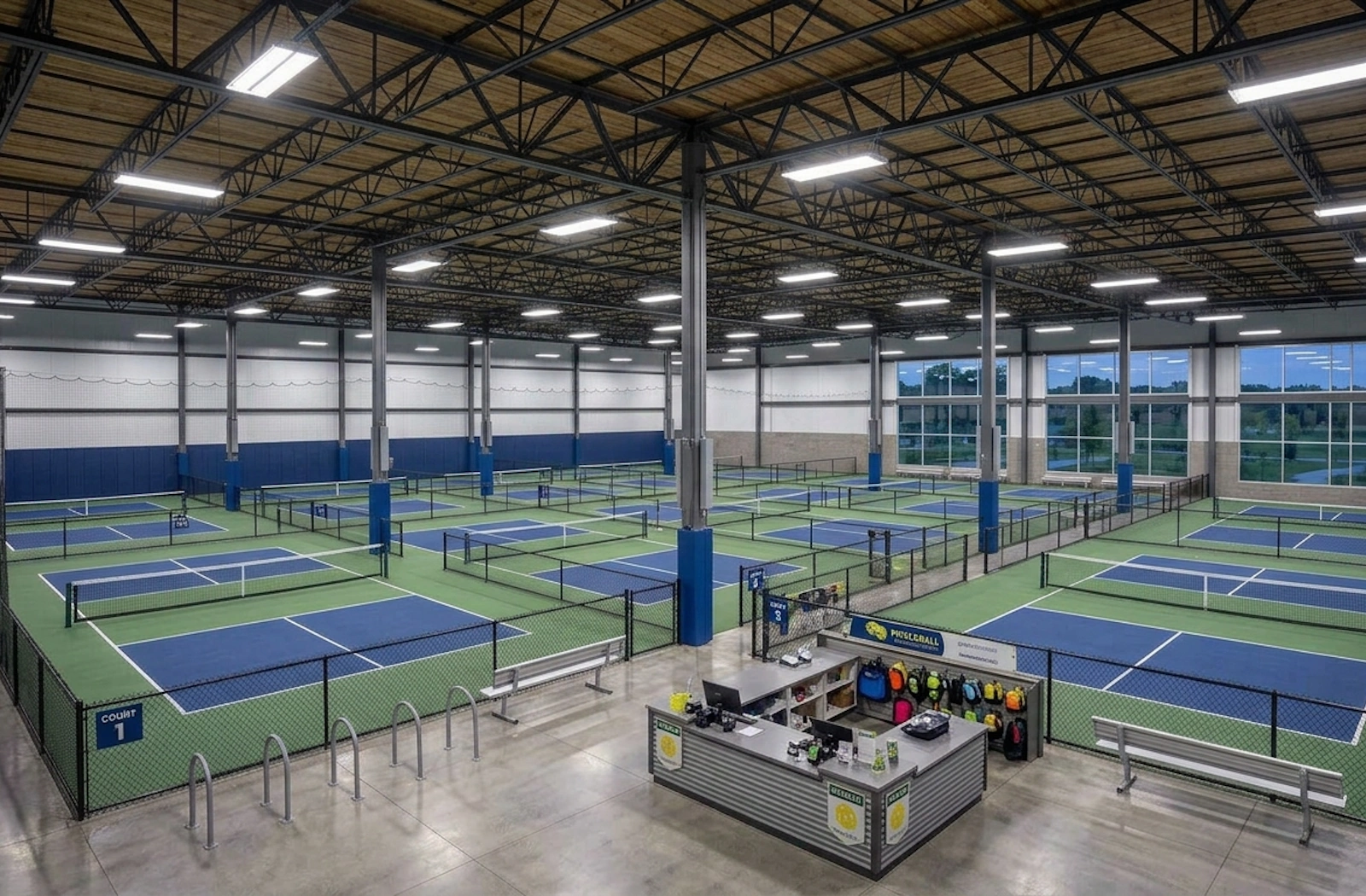
Indoor pickleball facilities are frequently built in large commercial spaces with high ceilings, exposed structure and multiple courts. That can make standard high-bay fixtures look like an easy answer. The problem is that a warehouse and a pickleball court ask people to look at the light in completely different ways.
Warehouse lighting is primarily designed around work surfaces, aisles and general horizontal visibility. Pickleball players repeatedly look across the building and upward into the airspace. A fixture arrangement that is perfectly acceptable over pallet racking can create harsh glare when it sits directly in a player’s line of sight or over the trajectory of a lob.
For indoor conversions, Creative Lighting can evaluate the existing electrical layout and high-bay equipment, identify whether fixtures can be repositioned or replaced, and help plan a system around the court grid. Ceiling reflectance, wall color, divider curtains, HVAC, sprinklers and other obstructions may also affect the final layout. Facilities converting a former industrial building should coordinate this page with our warehouse and industrial LED lighting expertise, but the sports application should remain the controlling design goal.
- Keep high-intensity sources out of frequent player sightlines
- Coordinate fixture placement with nets, curtains and ceiling structure
- Plan court-by-court or zone controls when the operating model supports it
- Consider flicker performance where video, training or livestreaming matters
- Use durable equipment suitable for the mounting height and facility conditions
Outdoor Systems Have to Control the Edge of the Court as Carefully as the Center
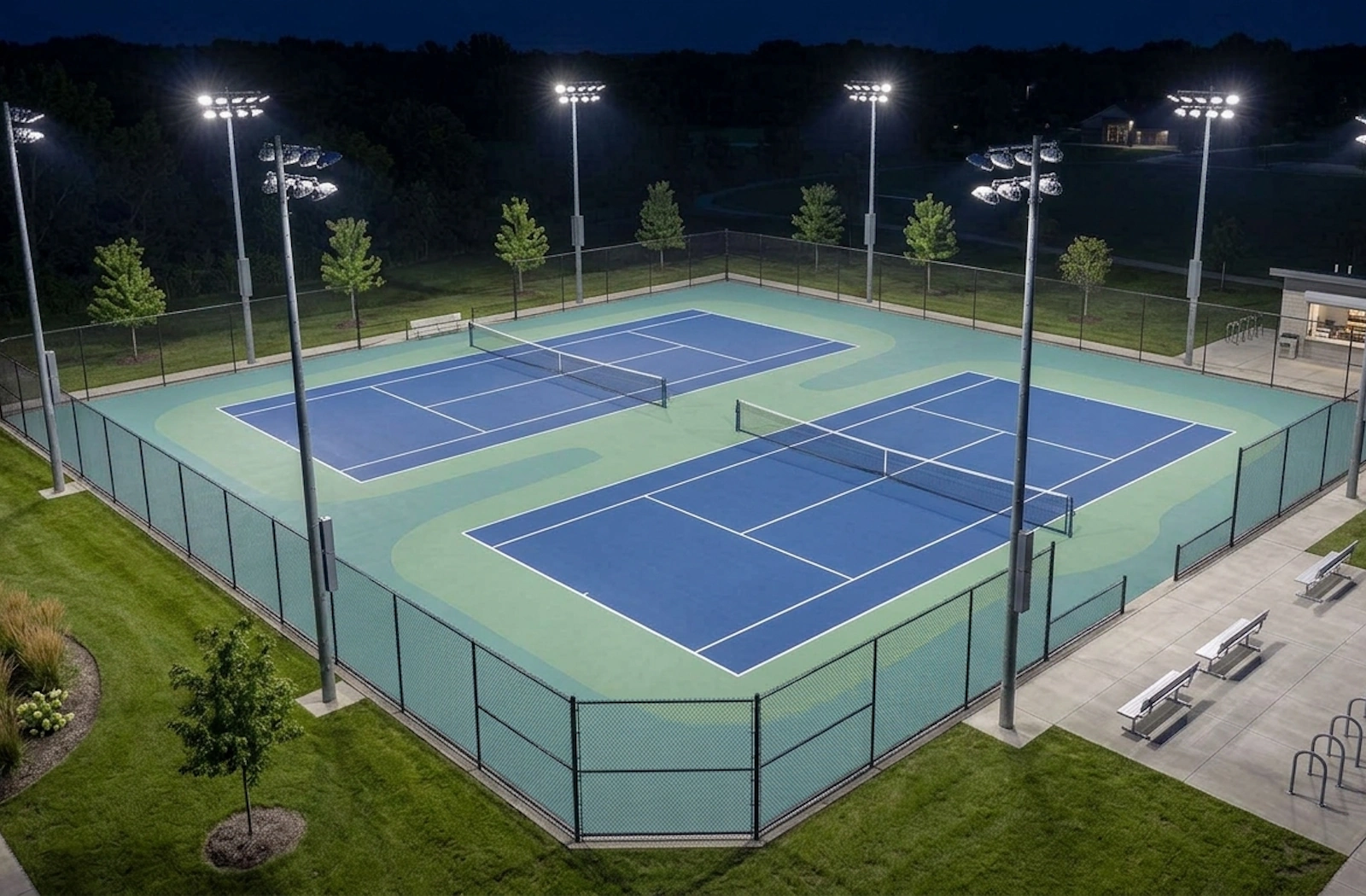
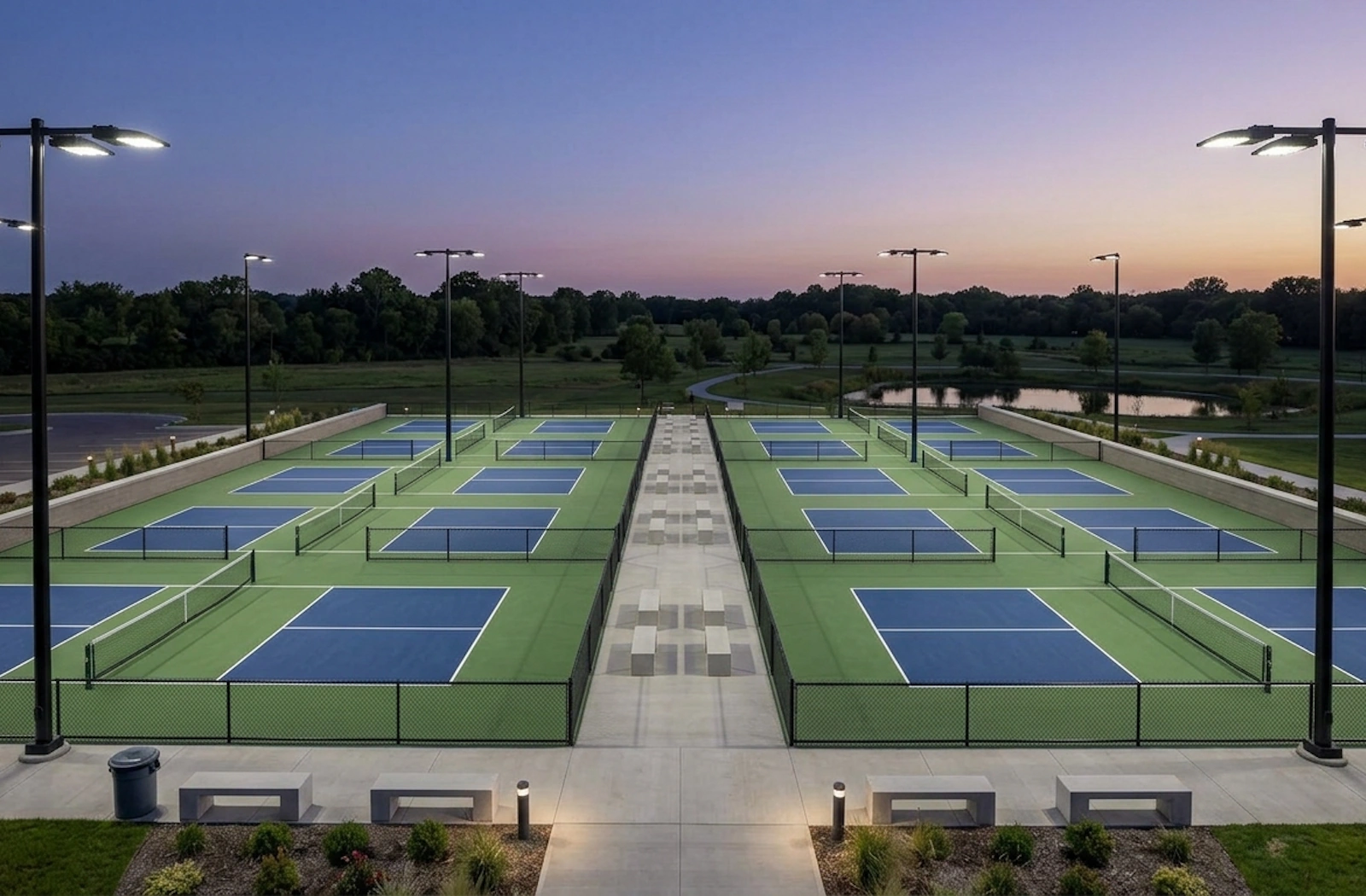
Outdoor pickleball lighting adds pole geometry, weather exposure and neighboring properties to the design problem. The lights need to cover the court without producing unnecessary brightness beyond the fence. That is especially important for country clubs, HOAs, municipalities, schools, resorts and private facilities where evening play may take place near residences or guest areas.
Existing tennis or sports-court poles can sometimes be useful starting points, but they should not be assumed to be correct for a pickleball conversion. Pole spacing, height, structural condition and the aiming angles required by the new court layout all need to be reviewed. Reusing the wrong geometry can force a new LED fixture to solve a problem it was never positioned to solve.
Environmental conditions also matter. Long Island sites deal with winter weather, wind and seasonal operating patterns. Southwest Florida projects around Naples can face heat, humidity, heavy rain and salt exposure depending on proximity to the Gulf. Fixture construction, coatings, electrical components and mounting hardware should be appropriate to the actual site.
Pickleball Lighting for Commercial, Community & Institutional Properties
Indoor Pickleball Clubs
Purpose-built clubs and converted commercial buildings with multiple courts, memberships, leagues, lessons and extended operating hours.
Country Clubs & Resorts
Premium environments where court performance, appearance, guest comfort and off-court spill control all matter.
HOAs & Residential Communities
Shared amenities that often require careful control of glare, operating hours and light reaching neighboring homes.
Municipal & Public Recreation
Community courts and recreation complexes that need durable equipment, controllable operating hours and dependable visibility.
Schools & Campuses
Multi-use recreation areas, PE facilities and athletic complexes where pickleball may share space or infrastructure with other sports.
Developers & Property Owners
New amenity projects and adaptive-reuse facilities that need lighting coordinated early with construction, electrical and operating plans.
A Practical Four-Step Approach to Pickleball Court Lighting
1
Site & Goal Review
Start with court count, layout, photos, dimensions, existing fixtures or poles, operating hours, known complaints and the level of play the facility wants to support.
2
Lighting Strategy
Determine whether the project is a retrofit, fixture replacement or redesigned system. Establish the role of photometrics, controls and any special environmental or neighborhood constraints.
3
Fixture & Layout Planning
Match fixture optics, output and mounting to the actual court geometry. Review expected coverage before equipment is committed whenever the project warrants formal photometric analysis.
4
Project Coordination
Provide equipment and lighting guidance to the owner, electrical contractor, facility team or other project professionals so the intended design is carried through to the field.
Two Priority Markets. One Commercial Lighting Standard.
Creative Lighting is headquartered in Plainview, New York, so Long Island remains the strongest local market signal on this page. Naples and Southwest Florida are also priority project markets. The page should communicate real project capability in both regions without inventing a Florida office, fake address or duplicate local-business entity.
LED Pickleball Court Lighting on Long Island, NY
For Long Island projects, Creative Lighting can support indoor and outdoor pickleball facilities throughout Nassau and Suffolk County with lighting design guidance, retrofit planning, fixture selection, photometrics and controls. The Plainview office and local number, (516) 741-6333, should remain clearly visible while the toll-free number stays the primary project CTA.
Existing clubs, schools, municipalities and commercial facilities may also have an opportunity to evaluate energy-efficiency incentives. PSEG Long Island maintains commercial efficiency programs and directs customers to Prime Efficiency Partners for qualifying projects. Eligibility, measure requirements and pre-approval can change, so rebate language on this page must remain conditional rather than promising a specific dollar amount.
Review PSEG Long Island commercial lighting rebate guidance →
LED Pickleball Court Lighting in Naples, FL
Naples and the surrounding Southwest Florida market are a major growth opportunity for pickleball facilities, clubs, resorts, HOAs and community amenities. Creative Lighting can support qualified projects in Naples, Bonita Springs, Estero, Fort Myers and nearby Southwest Florida communities with the same design-first approach used in New York.
Florida projects should account for the actual site environment, including outdoor exposure, operating hours, neighboring residences or guest areas and local permitting or property requirements. For coastal properties, equipment selection may also need to consider corrosion resistance and serviceability in humid, salt-influenced conditions.
Creative Lighting does not claim a Naples storefront or local Florida office on this page. The correct message is project support in Naples and Southwest Florida from an established commercial lighting company with a Plainview, New York headquarters and nationwide project capability.
Use Better Controls So an Empty Court Does Not Stay Lit All Night
LED fixtures create the opportunity for more deliberate control than many legacy sports-lighting systems. The right strategy depends on the facility, but multi-court clubs may benefit from separating banks of courts, while outdoor facilities may need scheduled shutoff tied to operating hours. Some projects may also use occupancy or centralized control platforms.
Controls should be planned with the operating model. A busy club with late leagues has different needs than an HOA amenity with a strict closing time. A municipality may prioritize centralized scheduling and predictable shutoff. A resort may need staff-friendly controls that make it difficult to leave unused courts on.
Energy savings should never be presented as a universal percentage without knowing the existing system, proposed wattage and operating hours. Creative Lighting can help compare the current load with proposed equipment and controls so the owner has a realistic project-specific picture.
Commercial Lighting Experience Matters When the Court Has to Perform After Dark
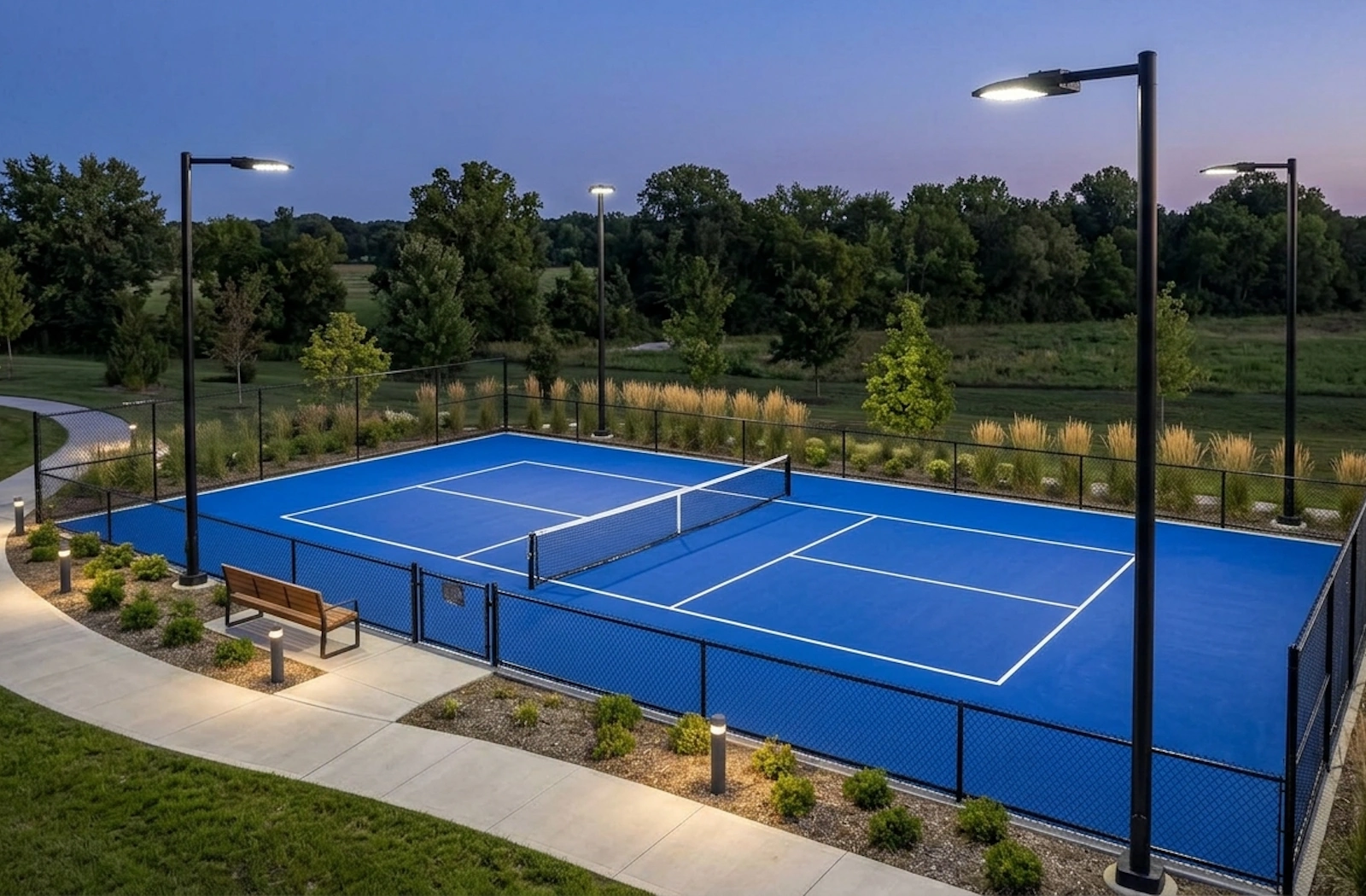
Creative Lighting Solutions has worked in commercial lighting since 1965. The value of that history is not nostalgia; it is perspective. Lighting technologies change, but the underlying job remains the same: understand the space, understand what people need to see, select equipment that fits the application and make the project practical to operate and maintain.
Pickleball projects sit at the intersection of sports lighting, commercial facility planning, electrical infrastructure, controls and energy efficiency. That makes them a natural extension of Creative Lighting’s broader work in commercial LED lighting, lighting design and sports facilities.
We are positioned as a lighting sales, consulting, design and energy-solutions partner. The page should not turn that into a claim that Creative Lighting self-performs every electrical installation. Where field installation is required, equipment and design guidance can be coordinated with the facility’s electrical contractor and project team.
Start With These Project Details
- Facility address and primary contact
- Indoor or outdoor court count
- Photos from court level and from outside the fence
- Court dimensions and layout if available
- Pole or ceiling mounting heights
- Existing fixture model, wattage or photos
- Hours of operation
- Known glare or spill-light complaints
- New construction, retrofit or expansion
- Desired schedule and budget range
Useful Pickleball Lighting & Energy-Efficiency References
Serious lighting pages should point users toward authoritative resources rather than pretending every engineering question can be answered in a sales paragraph. These references give facility owners a stronger starting point for planning and verification.
Questions Facility Owners Ask Before Upgrading Court Lights
What makes pickleball court lighting different from general outdoor lighting?
Pickleball requires players to track a small, fast-moving ball across the court and into the air. That makes uniformity, glare control, vertical visibility and fixture placement more important than simply achieving a bright average light level.
Does Creative Lighting serve Long Island pickleball facilities?
Yes. Creative Lighting is based in Plainview, New York and supports commercial lighting projects across Long Island, including Nassau and Suffolk County. Call the Long Island office at (516) 741-6333 or the primary toll-free project line at (888) 614-1688.
Can Creative Lighting support pickleball court lighting projects in Naples, Florida?
Yes, for qualified commercial projects. Naples and Southwest Florida are priority project markets, including nearby communities such as Bonita Springs, Estero and Fort Myers. Creative Lighting’s headquarters remains in Plainview, New York; this page should not represent a separate Naples office.
Do you work with both indoor and outdoor pickleball courts?
Yes. Indoor and outdoor facilities require different approaches. Indoor projects focus heavily on ceiling geometry, player sightlines, glare and multi-court zoning. Outdoor projects add pole layout, aiming, weather exposure, spill light and neighboring-property considerations.
Do pickleball courts need a photometric lighting plan?
Not every small project needs the same level of analysis, but photometric planning is valuable for multi-court facilities, new construction, major retrofits and sites where uniformity, glare or spill light is a concern. The plan should use actual court geometry and manufacturer photometric data.
Can existing metal halide pickleball lights be replaced with LED?
Often, yes. The best approach depends on the existing poles, mounting height, electrical system and current distribution. A successful retrofit should compare coverage and aiming, not just old wattage versus new wattage.
Can we reuse our existing court light poles?
Possibly. Pole location, height, condition and structural capacity must support the proposed fixture and layout. Reusing poles can be economical, but poor pole geometry can also limit glare control and uniformity.
How can LED pickleball lighting reduce glare?
Glare control depends on optics, shielding where appropriate, fixture aiming, pole position, mounting height and the relationship between the light source and common player viewing angles. There is no single anti-glare fixture that fixes every court layout by itself.
Can the lights be controlled court by court?
Many multi-court facilities can be divided into useful control zones, depending on the electrical design and selected system. Zoning can allow operators to illuminate only the courts or groups of courts that are scheduled for use.
Are PSEG Long Island rebates available for pickleball court LED lighting?
PSEG Long Island offers commercial efficiency programs, but eligibility depends on the customer, equipment, program rules and approval requirements in effect for the specific project. Creative Lighting can help Long Island customers review current opportunities without promising a rebate before eligibility is confirmed.
What information do you need to review a pickleball lighting project?
Useful starting information includes the facility address, court count, indoor or outdoor setting, photos, court layout, pole or ceiling heights, existing fixture information, hours of operation, known glare or spill issues and whether the project is new construction or a retrofit.
What is the first step?
Request a lighting review with the basic project information and photos. Creative Lighting can then determine what additional measurements, photometrics, fixture data or contractor coordination may be needed. Call (888) 614-1688 or (516) 741-6333.
Plan the Pickleball Lighting Before You Buy the Fixtures
Whether you are upgrading an existing club, converting a commercial building, adding courts to a community, or planning a new outdoor complex, start with the court geometry and performance goals. Creative Lighting can help evaluate the project, compare LED options and build a lighting strategy around the way the facility will actually be used.