Sports Facility LED Lighting Designed for Better Visibility, Control & Performance
Creative Lighting Solutions helps sports facilities plan commercial LED lighting upgrades for indoor courts, gymnasiums, fieldhouses, recreation centers, outdoor courts, athletic fields and multi-use venues. From photometric planning and fixture selection to energy-saving controls and project guidance, the goal is straightforward: put the right light where athletes, staff and spectators actually need it.
More Light Is Not the Same as Better Sports Lighting
A sports facility can have plenty of light and still perform badly. Bright fixtures pointed in the wrong direction can create glare. Uneven coverage can make a ball disappear as it crosses from a bright zone into a darker one. Poor fixture placement can leave shadows around baskets, nets, sidelines or goal areas. Outdoor systems can spill light beyond the playing surface and create problems for neighboring properties.
That is why a serious LED sports lighting project starts with the facility, the sport, the mounting conditions and the operating goals rather than with a fixture catalog. Creative Lighting helps owners, facility managers, schools, clubs, municipalities and commercial operators evaluate the practical details that determine how a lighting system will actually work.
For existing facilities, that may mean reviewing current metal halide, fluorescent or older LED equipment and determining whether a retrofit, fixture replacement or redesigned layout makes more sense. For new or renovated facilities, it can mean coordinating fixture types, mounting heights, controls and light distribution before installation decisions are locked in.
What We Evaluate
- Sport and level of play
- Indoor or outdoor environment
- Ceiling height, poles and mounting locations
- Existing fixture type and wattage
- Horizontal and vertical light needs
- Uniformity across the playing area
- Glare and light-spill control
- Color quality and visual clarity
- Controls, scheduling and dimming opportunities
- Energy use, maintenance and upgrade goals
One Sports Lighting Hub. Different Venues, Different Requirements.
This page should function as the central sports lighting authority page, while dedicated pages go deeper into individual court and field applications. That keeps the site organized for users and search engines instead of forcing every sport into one bloated page.
Gymnasium & Fieldhouse LED Lighting
Basketball, volleyball, school gyms, recreation centers and fieldhouses need bright, even coverage while controlling glare at typical player sightlines. High ceilings, trusses, scoreboards and retractable equipment all influence fixture placement.
Pickleball Court Lighting
Fast ball movement, multiple adjacent courts and player viewing angles make distribution and glare control especially important. Multi-court facilities also benefit from zoning and controls that let operators light only the courts being used.
Tennis Court LED Lighting
Tennis lighting must support ball tracking across the full court and above the net while limiting glare from fixtures positioned around the playing area. Outdoor sites also require careful attention to spill light and nearby properties.
Field & Stadium Lighting
Large athletic fields require purpose-built optics, mounting plans and high-output fixtures designed to cover long distances while maintaining useful illumination and reasonable control beyond the field boundaries.
Recreation & Athletic Complexes
Multi-use buildings can combine courts, training areas, walking tracks, spectator zones, concessions and support spaces. Lighting should be planned as a system so each area performs properly without wasting energy when spaces are idle.
Training, Fitness & Specialty Sports Areas
Indoor turf, batting cages, ice facilities, training centers and specialty recreation spaces may need different fixture protection, mounting, color quality and control strategies. The application should drive the specification.
Design Around the Playing Surface, Not Just the Ceiling
Sports lighting is judged by what players can see, not by how impressive the fixtures look from a ladder. A strong plan considers the entire visual environment, including the path of a ball through the air, the contrast between surfaces, player sightlines, spectator viewing, ceiling and pole geometry, and any neighboring areas affected by the light.
- Illuminance: provide appropriate light levels for the sport and use of the venue.
- Uniformity: avoid dramatic bright and dark zones across the playing surface.
- Glare control: reduce direct visual discomfort at common player and spectator angles.
- Vertical visibility: support the ability to see balls, players and objects moving above the surface.
- Color quality: help court lines, uniforms, balls and surroundings remain visually distinct.
- Flicker performance: consider the needs of fast motion and video capture where applicable.
- Controls: use scheduling, zoning, occupancy or dimming where the facility can benefit.
What Separates a Serious Sports LED Upgrade From a Simple Fixture Swap
Mounting Height & Geometry
Ceiling height, pole position, trusses, obstructions and available mounting points affect beam selection and aiming. A fixture that works at one height may be a poor fit at another.
Uniformity & Distribution
Useful sports lighting depends on how evenly light reaches the playing area. Photometric planning helps evaluate distribution before fixtures are purchased and installed.
Glare Management
Athletes routinely look upward and across a field or court. Optics, shielding, fixture placement and aiming should be considered from those real viewing directions.
Controls & Scheduling
Multi-court and multi-field facilities may not need every light at full output all day. Controls can support court-by-court use, reduced-output periods and more efficient operating schedules.
Existing Electrical Conditions
Retrofit planning should account for voltage, circuits, controls, mounting hardware and the condition of the existing electrical system before a final equipment plan is approved.
Maintenance Access
High ceilings and tall poles make maintenance expensive. Long-life LED systems can reduce routine lamp replacement, but fixture access and serviceability should still be part of project planning.
Outdoor Spill Light
Outdoor sports facilities must consider property lines, neighboring buildings and the night environment. Better optical control can help keep more light on the intended playing surface.
Future Use
A facility built for recreation today may host leagues, tournaments, events or video production later. Planning for realistic future needs can prevent another costly redesign.
LED Lighting for Gyms, Courts, Fieldhouses & Indoor Athletic Centers
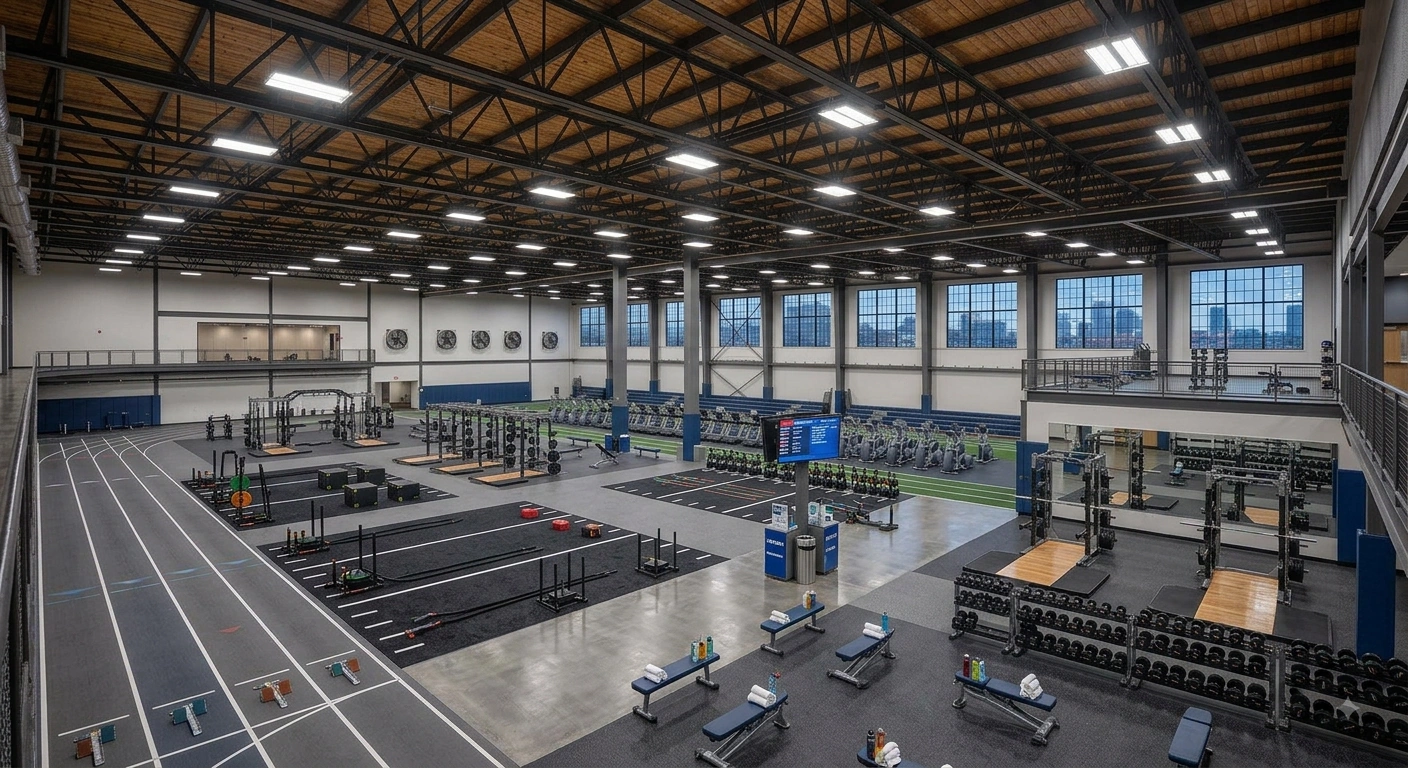
Indoor sports facilities often have high ceilings, structural beams, HVAC equipment, scoreboards and other obstructions that make one-for-one fixture replacement less straightforward than it looks. A good upgrade should improve the playing environment without creating harsh hot spots directly under fixtures or leaving dim areas at the perimeter.
LED high-bay and purpose-built sports luminaires can provide fast start-up, controllability and efficient light output, but fixture selection still needs to match the space. Basketball and volleyball players look upward repeatedly. Pickleball and tennis players track a small fast-moving ball across a wide field of view. Spectator and walking areas may need a different balance of brightness and comfort than the court itself.
For facilities that host different sports, practices, tournaments or community events, zoning and dimming can be particularly valuable. Operators can create practical lighting scenes instead of treating the building like a single giant on/off switch.
Keep the Light on the Field, Court or Playing Area
Outdoor sports lighting has a second audience beyond the players: everyone living or working around the facility. Poorly controlled fixtures can send light into windows, above the horizon or far beyond the property. Modern LED optics give designers more control, but only when the system is selected and aimed for the site.
Outdoor projects should consider pole locations, fixture mounting heights, the size and orientation of the playing surface, neighboring property, expected hours of operation and the level of play. A municipal recreation field has different requirements from a private tennis club or a tournament complex, and a system should not be oversized simply because a higher wattage fixture is available.
Creative Lighting can help customers think through the equipment and design questions before they invest, including whether an existing pole system can support an LED conversion or whether a broader redesign is appropriate.
Sports Facilities Often Have More to Gain Than Just Brighter Light
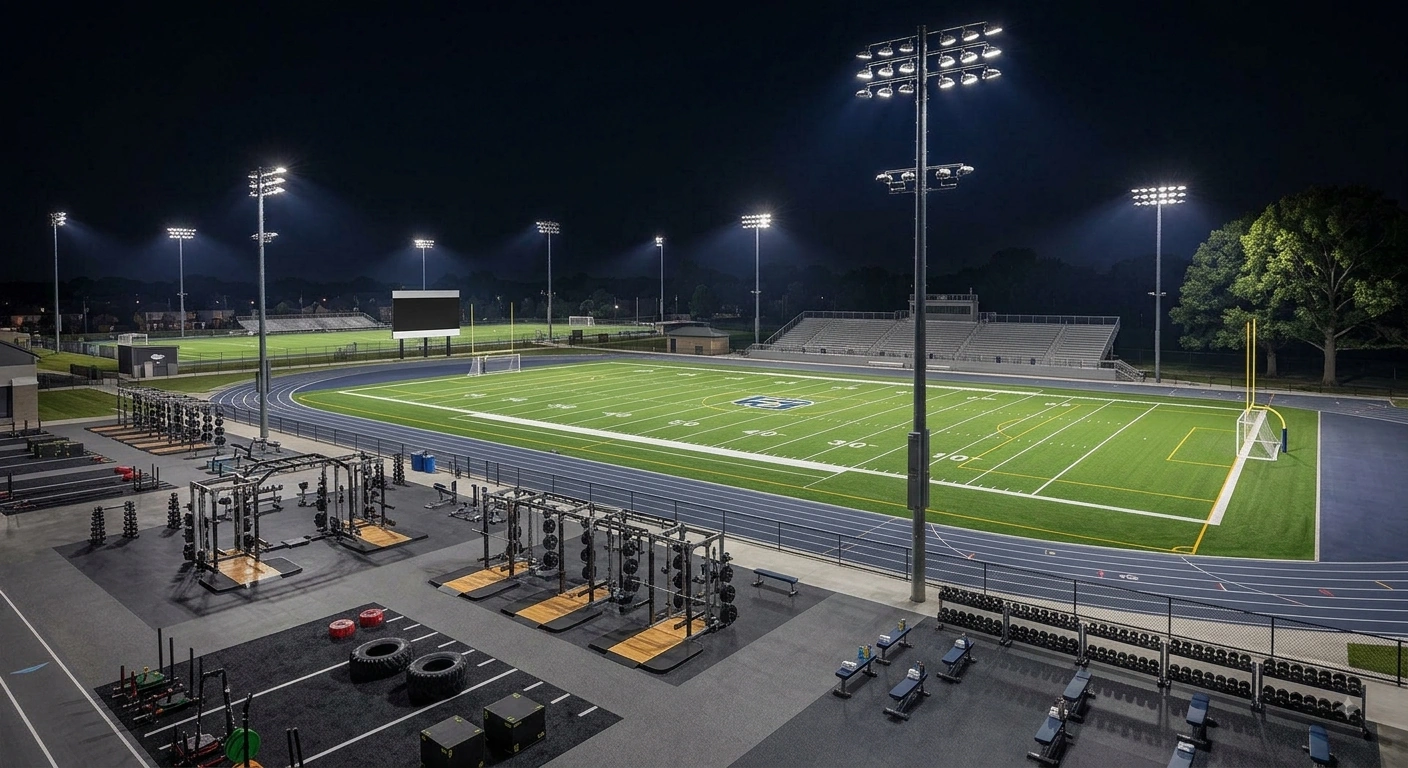
Older sports facilities may still rely on metal halide, high-intensity discharge, fluorescent or first-generation LED equipment. In many cases, the operating cost is affected by more than fixture wattage. Long run times, warm-up delays, maintenance at difficult mounting heights and the inability to control individual areas can all add cost.
Commercial LED luminaires can also work with control strategies such as occupancy sensors, task tuning and dimming. The U.S. Department of Energy notes that these controls can support additional energy savings when appropriate. The correct savings estimate, however, should come from the actual facility, existing equipment and operating schedule rather than a generic percentage pasted onto a sales page.
Creative Lighting can review the current system and help facility owners compare potential LED upgrade paths based on performance, energy use and operating goals.
Useful Information for an Initial Review
- Facility address and ZIP code
- Indoor or outdoor
- Sport or sports played
- Approximate facility or court dimensions
- Existing fixture quantity and type, if known
- Ceiling height or pole height, if known
- Typical weekly operating hours
- Photos of the current lighting
- Known glare, dark-zone or maintenance problems
- Any planned renovations or expansion
Long Island Is the Local Base. Florida Is Project Coverage, Not a Fake Second Office.
Creative Lighting Solutions / CLF Sales Inc. is based at 23 East Mall in Plainview, New York. That Plainview location and the Long Island phone number remain the primary local signals for the business. Sports lighting projects can also be supported in Florida and other locations nationwide without changing or muddying the official New York business location.
Long Island & New York Sports Lighting
For New York projects, the page should naturally reinforce Plainview, Nassau County, Suffolk County and the broader Long Island market. The local number, (516) 741-6333, should remain visible alongside the toll-free project number.
Eligible Long Island commercial lighting projects may also have access to current PSEG Long Island efficiency programs. Rebate availability and eligibility can change, so project-specific guidance should point customers toward the current program rather than promising a fixed incentive.
Local office: 23 East Mall, Plainview, NY 11803
Long Island: (516) 741-6333
Toll Free: (888) 614-1688
Naples & Southwest Florida Sports Lighting Projects
Florida should be woven into this page as a genuine project-support market, not as a fabricated local office. A concise Southwest Florida section can mention projects in and around Naples, Bonita Springs, Estero and Fort Myers when those areas reflect the company’s real operating footprint.
Do not dump every Naples or Collier County ZIP code onto this sports hub. That adds very little for a broad sports-lighting page and can dilute the stronger Long Island local entity signals. If Florida search demand becomes a major growth channel, build a dedicated Southwest Florida commercial LED or sports-lighting landing page later and place the deeper city/ZIP coverage there.
Florida / Nationwide project support: (888) 614-1688
No separate Florida office is implied on this page.
Build the Page Around Real Lighting Standards, Not Marketing Superlatives
Sports lighting requirements vary by sport, facility, level of competition and environment. The Illuminating Engineering Society maintains recommended practice for sports and recreational lighting, and sport-specific governing bodies may publish additional guidance. Outdoor projects may also need to consider local codes and light-spill requirements. The page should reference credible sources without pretending that one generic lux or foot-candle target fits every project.
For pickleball facilities, USA Pickleball specifically emphasizes proper lighting for ball tracking, reduced eye strain and consistent playing conditions. For outdoor sites, DarkSky International publishes sports-lighting criteria focused on issues such as glare, spill light and sky glow. Commercial LED equipment and controls can also be evaluated against current efficiency and product-quality requirements.
Commercial Lighting Experience That Predates the LED Era
Creative Lighting has been serving commercial customers since 1965. That matters because an LED project is not just about buying the newest fixture. Sports facilities often have older electrical systems, existing poles or high-bay layouts, mixed-use spaces, difficult maintenance access and operating schedules that developed over years.
The company’s role is to help customers evaluate the project with those real-world conditions in mind. For Long Island customers, Creative Lighting also provides PSEG Long Island rebate awareness and project guidance when applicable. For Florida and nationwide projects, the focus remains commercial LED product knowledge, lighting design support and practical project planning.